

Software promised to change the way we learn. Instead, students got more buttons and more passive video. Interaction became restrictive and learning methods more bounded.
As a result, students continue to use the same tools that have been around for centuries, pen and paper.
We need to be able to think freely: the proof, the sketch, the false start, the diagram, the moment when you can finally see the idea.
Let's remove the friction and get back to the basics.
Proven across memory, math, and science.
Thinking happens when students put ideas onto a page. Writing and note-taking are not just slower versions of typing; studies show that recall strengthens, conceptual processing deepens, learning accelerates, and memory traces strengthen when learners physically form letters, words, and diagrams.
The same pattern appears when students draw scientific systems and generate their own diagrams: comprehension improves, reasoning becomes more successful, and cognitive load falls.
We're changing the way digital education works.
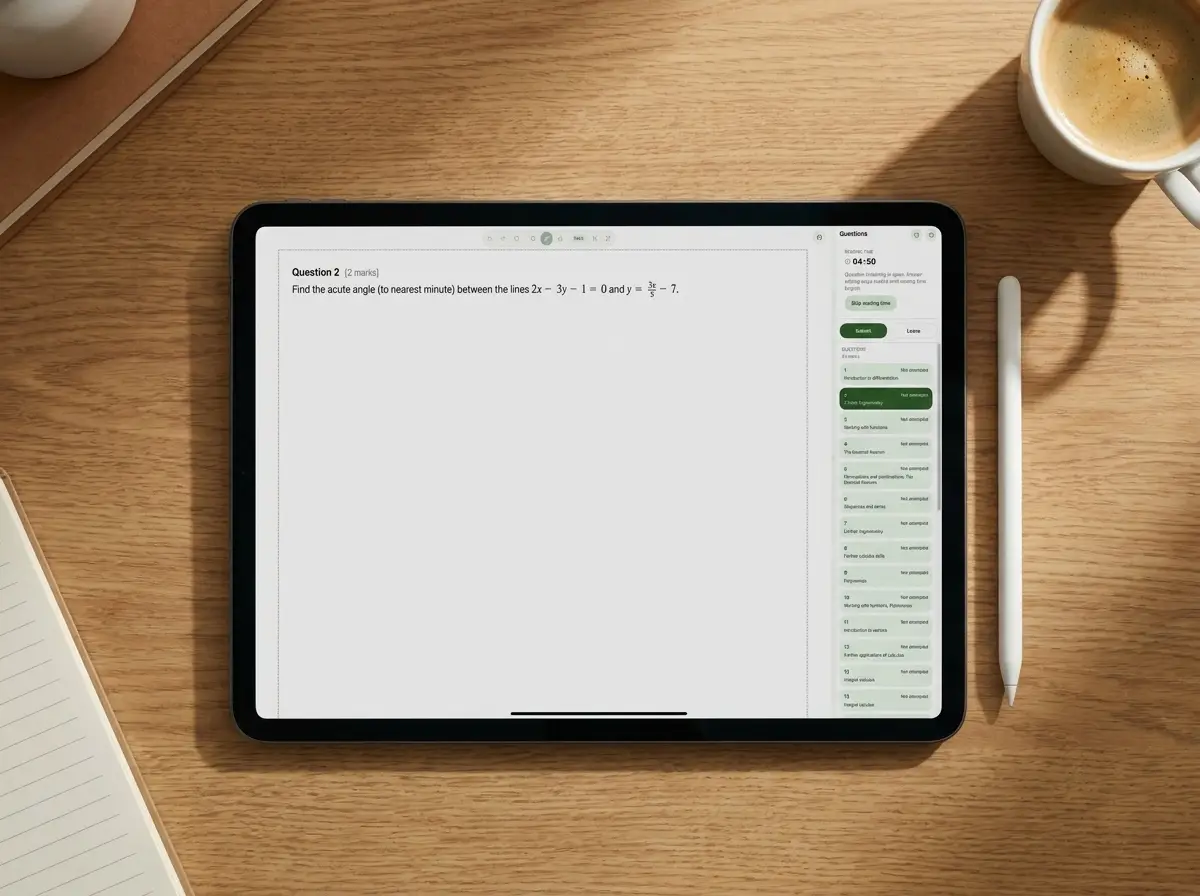
Practice like it's the real thing
Time remaining
42:00
Get attempts marked with feedback
Highlight areas for improvement
Physics
Maths
History